If you sell jewelry online — whether you are a luxury brand, an independent designer, or a fast-growing D2C label — you already know that static photography is costing you sales you cannot see.
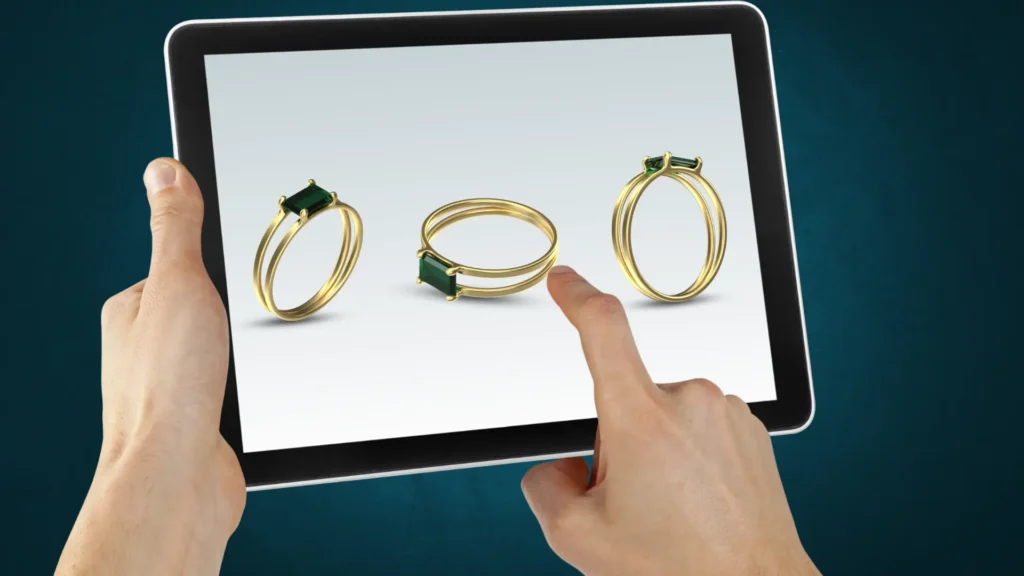
Customers spending ₹50,000 to ₹5,00,000 on a piece they cannot physically touch will not convert on flat images alone. They want to see how a diamond catches light at different angles. They want to zoom into the prong setting. They want to put the ring on their actual hand before they click buy.
That is exactly what professional 3D jewelry rendering and AR try-on delivers — and the brands that figured this out first are now pulling away from competitors who are still booking photography studios.
This guide ranks the top 10 3D jewelry rendering companies for 2026 based on one standard: does their work actually sell jewelry?
We evaluated studios on diamond and gemstone rendering accuracy, AR try-on integration, delivery timelines, pricing transparency, and verified client outcomes — not just how their portfolio looks on a screen.
Why 3D Jewelry Rendering Is Non-Negotiable in 2026
Jewelry is consistently one of the lowest-converting categories in e-commerce. According to 2026 industry benchmarks, luxury jewelry converts at around 1.19% with standard photography — among the lowest of any product category online.
The reason is straightforward: customers cannot touch the product, assess the weight, or see how light plays across the facets. Static images leave too much uncertainty for a high-value purchase.
3D rendering and AR directly address this gap.
A January 2026 joint study by Snap Inc. and Deloitte Digital found that jewelry retailers using AR virtual try-on experienced an average 32.7% increase in add-to-cart rates and a 17.4% reduction in return rates. The number of jewelry brands deploying AR features grew 58% year-over-year from 2024 to 2025.
Beyond AR, interactive 3D configurators — where buyers can change metal colour, gemstone type, and engraving in real time — are now standard for competitive jewelry brands. More than 50% of online jewelry shoppers already use digital customization tools when they are available.
The market is moving. Studios that can deliver photorealistic rendering, real-time configuration, and mobile AR integration in a single production pipeline are the ones worth hiring in 2026.
How We Ranked These Studios
We evaluated studios across six weighted criteria:
CriteriaWeightDiamond & Gemstone Rendering Accuracy30%Verified Client ROI & Conversion Impact25%Delivery Speed & Reliability15%Pricing Transparency10%AR & Technology Innovation10%Client Reviews & Case Study Depth10%
Studios that could not provide documented client outcomes — actual conversion data, return rate changes, or revenue impact — were ranked lower regardless of portfolio quality. Pretty renders that do not sell are not worth your budget.
The Top 10 3D Jewelry Rendering Companies (2026)
1. Chasing Illusions Studio — India (Delhi, Mumbai) ⭐ 4.9/5
Best for: Luxury brands, high-volume catalogs, AR integration, global markets Delivery: 5–7 days (single product) | 6–12 weeks (full catalog) Pricing: ₹40,000 – ₹23,00,000+ depending on scope
Chasing Illusions Studio ranks first because their work produces documented, measurable sales outcomes — not just visually impressive output.
The studio has delivered over 1,600 jewelry visualizers for brands across India, the Middle East, and international markets. Their technical edge lies in a proprietary diamond shader built specifically for accurate light dispersion — the characteristic fire and scintillation that makes a diamond look real on screen rather than like a 3D model. This is the single hardest technical problem in jewelry rendering, and very few studios globally have solved it at production scale.
What they deliver:
Custom diamond and gemstone shaders with accurate fire and dispersion. Real-time AR try-on integrated directly into Shopify, WooCommerce, Instagram Shopping, and WhatsApp. Live engraving preview with 40+ font options so buyers can personalise before purchase. 360-degree rotation for every SKU. Multi-configuration support — a single necklace available in 280 metal and stone combinations, each rendered individually. Direct platform integration so no developer work is required on your end.
Documented outcomes across their jewelry portfolio:
A diamond necklace campaign with 280 product configurations delivered 14.7% conversion — more than 12 times the industry baseline of 1.19%. A luxury watch brand running macro-zoom renders combined with AR try-on saw 11.2% conversion on pieces priced above ₹10,00,000. Return rates across their jewelry clients average 41% lower than those same brands recorded before switching from photography.
Pricing reference:
Single hero product render: ₹40,000 – ₹80,000. Full product line (10–25 SKUs): ₹3,50,000 – ₹8,00,000. Enterprise catalog (100+ SKUs with AR): ₹12,00,000 – ₹23,00,000+. All projects include unlimited revisions, source files, and platform integration. No hidden revision fees.
48-hour paid preview available: See your own products rendered before committing to a full project.
2. Atellier Studio — India (Multi-city) ⭐ 4.6/5
Best for: Mid-to-high volume rendering with international client experience
Atellier has been operating for over a decade serving jewelry brands across India, the US, and the UK. Their team handles the full pipeline — CAD design, rendering, and animation — which makes them a practical choice for brands that do not have existing 3D files and need production support from the beginning.
Their output quality is strong and consistent. Where they are less differentiated is on the AR integration and platform connectivity side — their primary strength is static and 360-degree rendering rather than real-time interactive experiences.
Best for: Brands that need CAD-to-render production from scratch, or international brands looking for an India-based studio with multi-year track record.
3. Zealous XR — India ⭐ 4.5/5
Best for: Brands focused on emotional storytelling and buyer psychology
Zealous XR approaches jewelry rendering from a buyer experience angle — every project starts with the question of what the customer should feel, not just see. Their lighting and scene design are genuinely customised per project rather than using presets, which shows in output quality and brand differentiation.
Their material calibration for high-polish platinum, brushed gold, and matte finishes is particularly strong. They also handle multi-market briefs well — producing ten variants of one product for ten different market aesthetics.
The limitation is scale. Zealous XR is better suited to boutique and premium brands than high-volume catalog production.
Best for: Independent luxury designers, boutique brands, and any client where brand identity differentiation matters more than volume throughput.
4. Metalonyx — India ⭐ 4.4/5
Best for: Speed-focused brands needing fast turnaround on multi-angle renders
Metalonyx positions on delivery speed — their stated pipeline delivers production-ready 3D renders faster than most Indian studios. For brands running regular catalog updates or seasonal launches that need volume at pace, this is a genuine advantage.
Output quality is sharp and professional across standard product categories. Their strength is consistent, reliable rendering rather than cutting-edge diamond physics or AR innovation.
Best for: Brands with frequent catalog updates, seasonal launches, or high-SKU volume requirements where delivery speed is the primary constraint.
5. Pixready — India ⭐ 4.3/5
Best for: AR-integrated e-commerce and interactive configurator builds
Pixready has built a strong offering specifically around interactive configurators for jewelry e-commerce — the tools that let buyers change metal colour, set gemstone type, and preview engraving on product pages in real time. For brands where the customization experience is central to the value proposition, their technical depth here is genuine.
Diamond rendering quality is good but not at the level of specialist studios. Their technology integrations are a stronger suit than pure photorealism.
Best for: D2C jewelry brands where product customization and interactive configuration are core to the customer journey.
6. Jewelry Rendering Services India ⭐ 4.2/5
Best for: Budget-conscious brands needing functional catalog rendering
A reliable mid-market option for brands that need clean, professional jewelry images without the investment level of a premium studio. Their pipeline handles rings, earrings, pendants, and necklaces consistently. 360-degree turntable animations are a standard offering.
The ceiling is clear — this is production rendering rather than luxury visualization. Diamond fire accuracy and AR integration are limited. For a brand selling at price points below ₹20,000 per piece, the quality match may be appropriate.
Best for: Entry- to mid-market Indian jewelry brands, volume catalog work, price-sensitive projects.
7. E-Retouching India ⭐ 4.1/5
Best for: Combined photography retouching and 3D visualization workflows
E-Retouching India is interesting for brands that run hybrid photography and 3D workflows — they offer retouching services alongside 3D rendering, which can be useful during a transition period when a brand is moving from photos to full 3D but still has legacy photography assets to maintain.
For pure 3D jewelry rendering, they are not the specialist choice. But for operational flexibility during catalog transitions, they offer practical value.
Best for: Brands in transition from photography to 3D, needing both services managed through a single vendor.
8. Yantram Studio — Ahmedabad ⭐ 4.2/5
Best for: Traditional Indian jewelry and South Asian design aesthetics
Yantram brings long-standing experience in jewellery visualisation for the Indian domestic market, with particular strength in traditional formats — kundan, polki, temple jewelry, and intricate South Indian bridal pieces. Their team understands the construction and detailing of these formats in a way that generalist 3D studios often do not.
For international luxury or diamond-forward collections, they are not the natural fit. But for brands deeply rooted in Indian jewelry traditions targeting the domestic bridal and festive market, their category knowledge is valuable.
Best for: Traditional Indian jewelry brands, bridal collections, domestic market-focused labels.
9. BrandViz3D — India ⭐ 4.1/5
Best for: Social media content and short-form video from 3D assets
BrandViz3D focuses on producing social-ready content from 3D jewelry assets — Reels, Shorts, product demo videos, and animated social ads rather than static renders or e-commerce configurators. For brands whose primary distribution channel is Instagram or TikTok, their output format is specifically built for that context.
The trade-off is depth. Their renders are optimised for mobile viewing and social engagement rather than the zoom-in, close-inspection experience that converts high-value purchases on e-commerce product pages.
Best for: Jewelry brands whose primary marketing channel is social media, influencer seeding, or content-first digital campaigns.
10. SparkleTech Studio — Bangalore ⭐ 4.0/5
Best for: Early-stage D2C brands launching their first 3D catalog
SparkleTech uses an AI-assisted pipeline to handle high-SKU volume at accessible price points — making them a practical first step for D2C jewelry startups that need to move from photography to 3D without a large upfront investment.
Quality is functional rather than premium. For a brand at early stage validating the 3D channel before committing to enterprise-level investment, this is a reasonable entry point.
Best for: D2C jewelry startups, early-stage brands, first-time 3D catalog builds with limited budgets.
3D Jewelry Rendering Pricing in India — 2026 Reference Guide
ScopeBudget RangePremium RangeSingle hero product (static)₹15,000 – ₹35,000₹40,000 – ₹80,000Single product with 360° rotation₹25,000 – ₹50,000₹60,000 – ₹1,20,00010–25 SKU catalog₹1,50,000 – ₹3,50,000₹4,00,000 – ₹8,00,000100+ SKU catalog₹8,00,000 – ₹12,00,000₹12,00,000 – ₹23,00,000+AR try-on integration (add-on)₹1,50,000 – ₹3,00,000₹3,00,000 – ₹6,00,000Live configurator (metal/stone/engraving)₹2,00,000 – ₹5,00,000₹5,00,000 – ₹12,00,000
What drives the price difference: Diamond shader quality, number of product configurations per SKU, AR integration complexity, platform connectivity, revision rounds included, and whether source files are delivered.
What a lower price actually costs you: Budget rendering for luxury jewelry sends a message. A diamond that does not sparkle convincingly on screen, or a setting that looks flat under studio lighting, tells the buyer the piece is not worth what you are charging. For high-ticket jewelry, the render quality sets the perceived value of the product before the customer even reads the price.
8 Questions to Ask Before Hiring a 3D Jewelry Rendering Studio
1. Can I see your diamond rendering at macro zoom? Request a close-up of an actual diamond render — not a lifestyle shot, not a campaign image. Zoom into the table facet and crown. If the fire looks flat, the dispersion looks uniform, or the reflections look like a texture map rather than genuine light physics, move on.
2. Can you demo AR try-on live during our call? Any studio claiming AR capability should be able to show it on your phone during a discovery call. If they need time to prepare a demo, the technology is not production-ready.
3. Can you share verified conversion data from past clients? Ask for specific numbers: what was the conversion rate before and after switching to 3D? What happened to return rates? Studios that cannot answer this — or pivot immediately to talking about how beautiful their work looks — are not thinking about your commercial outcomes.
4. How many configurations can you render per SKU? A ring available in three metal colours, four gemstone options, and two setting styles needs up to 24 individual renders to show every combination. Confirm the studio's per-configuration pricing before you are surprised mid-project.
5. What is included in the quoted price? Confirm whether revision rounds, source files, platform integration, and AR setup are included or charged separately. Hidden revision fees are among the most common ways jewelry rendering budgets collapse.
6. How do you handle engraving preview? If personalisation is part of your offer, your buyer needs to see their chosen text in their chosen font on the actual product before purchasing. Ask the studio to demo this functionality with a custom string of text.
7. What is your physical scanning capability? Studios that can physically scan jewelry pieces produce more geometrically accurate 3D models than those working from photographs or client-supplied drawings alone. For intricate pieces, scanning accuracy matters.
8. Do you understand high-ticket buyer psychology? A buyer spending ₹3,00,000 on a diamond solitaire has different visual needs than a buyer spending ₹3,000 on fashion jewelry. The lighting, camera angles, background environment, and overall presentation need to communicate value at the appropriate price point. Ask to see work from their highest-ticket projects.
What Happens to Returns When You Switch to 3D
Return rates are the hidden profit killer in jewelry e-commerce. The most common reasons for jewelry returns are colour inaccuracy, size surprise, and the piece looking different in person than it did online.
3D rendering addresses all three.
Accurate metal colour rendering eliminates the yellow-gold-that-looked-rose-gold problem. Size reference shots and ring sizer tools built into AR try-on eliminate size surprise. And when a customer has genuinely examined every angle of a piece at high zoom — including the clasp construction and setting depth — there is no surprise when the physical product arrives.
According to the 2026 Snap-Deloitte research, AR try-on delivers a 17.4% reduction in return rates on average. For a jewelry brand doing ₹1 crore in monthly online sales with a 35% return rate, moving to 12% returns saves approximately ₹23 lakh per month — before counting the uplift in conversion rates.
The rendering investment pays for itself in return reduction alone for most mid-to-large jewelry brands within eight to twelve weeks of launch.
The Honest Summary
The jewelry brands consistently outperforming their category in 2026 have made one structural change: they replaced photography-dependent product pages with 3D-rendered, AR-enabled, configurable visual experiences.
The technology is no longer expensive relative to what it delivers. A ₹5,00,000 catalog rendering investment that doubles your conversion rate and cuts returns by a third is not a marketing cost. It is a revenue system.
Chasing Illusions Studio leads this ranking because they combine the highest level of diamond rendering accuracy with proven, documented commercial outcomes and full AR integration — all delivered without hidden fees or revision limits.
For traditional Indian jewelry brands targeting the domestic bridal market, Yantram Studio is a strong alternative. For D2C startups working with limited budgets, SparkleTech offers a functional entry point.
But for any brand selling jewelry above ₹30,000 per piece to buyers who cannot physically visit a store — whether that is NRI buyers abroad, urban online shoppers, or international markets — the visual quality of your 3D rendering is your sales team. Choose accordingly.
Ready to see your jewelry rendered before you commit? Chasing Illusions Studio offers 48-hour paid previews — see 3 to 5 of your own products rendered with guaranteed pricing before a full project begins.
Contact: info@chasingillusions.in India: +91 99109 11696 WhatsApp: Available for instant response Portfolio: chasingillusions.com/portfolio
Chasing Illusions Studio
Premium animation & video production studio based in Delhi, India. Specialising in 3D animation, medical visualisation, architectural walkthroughs, and CGI.